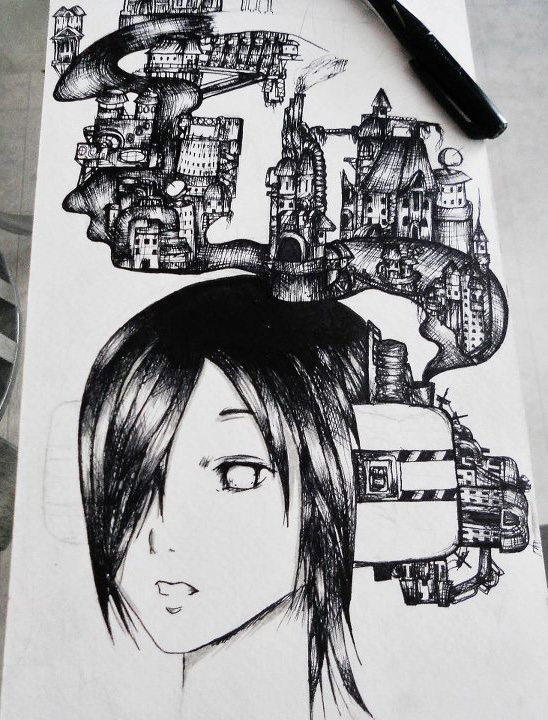
“The Designer at Work,” Julien Nicholas, silk screen, monoprint
VIA: How long have you been creating artwork and/or involved with the arts?
JULIEN: I’m not even sure I can recall how far back I began drawing and painting. I have been immersed in the arts from a very young age.
VIA: What is your medium of choice for creating your work?
JULIEN: I am a mixed media artist. I find it difficult to narrow down my medium of choice, however, I find myself using alcohol based markers more frequently than others.
VIA: What style or period of art inspires you as an artist? Who are some of your favorite artists?
JULIEN: Modern art and pop art are my main influences. Some of my favorite artists are Yoshitaka Amano, Audrey Kawasaki, and in photography, Richard Avedon.
VIA: What is your leading inspiration when you create your work?
JULIEN: My biggest inspiration in creating my work is music. Music influences the messages behind my work, the emotions they convey, and the overall themes. I am driven by music and use my favorite artists’ songs as my muse.
VIA: Are there other passions or interests you have that tie into your work at all?
JULIEN: One of my biggest passions has been and always will be fashion design. Having a background in costuming from a young age, I found myself very interested in design and construction of costumes and garments. My biggest influences being Alexander McQueen and Gareth Pugh, I am drawn to the odd and unique. These interests tie into my artwork in that my aesthetic strays from the ordinary and reaches for the unique and extraordinary.
VIA: What are your plans for after college?
JULIEN: After college I hope to move to New York City and continue my education by enrolling in FIT’s graduate program, in order to fuse my love for art and fashion.
This article was originally published in the third issue of VIA Noke Magazine, printed in Roanoke, Virginia in October 2012.
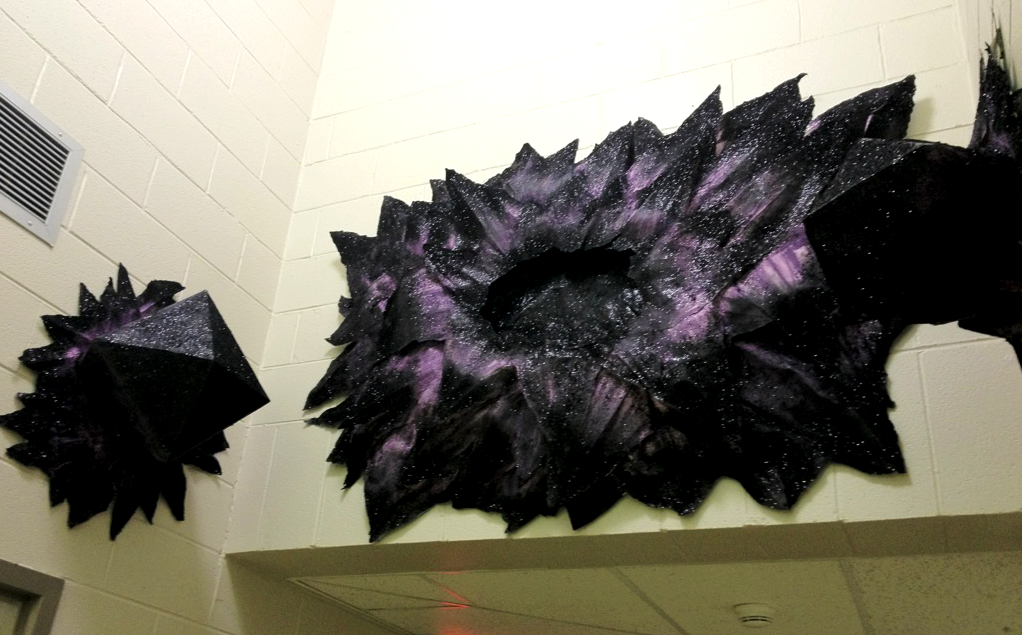
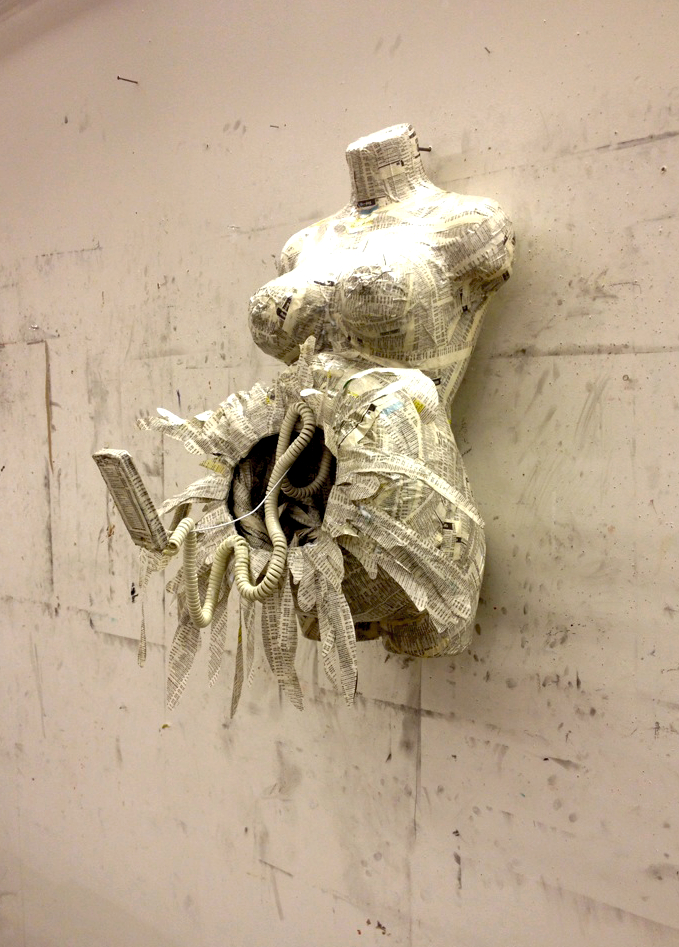
“Crystal Formation,” Julien Nicholas; ten yards of paper, foam board, acrylic paint, hot glue, black glitter; collaborative piece created with Kayla Lynch.“Birth of Technology,” Julien Nicholas; plastic mannequin, beach ball, entire phonebook, mod podge, wire, cardboard.
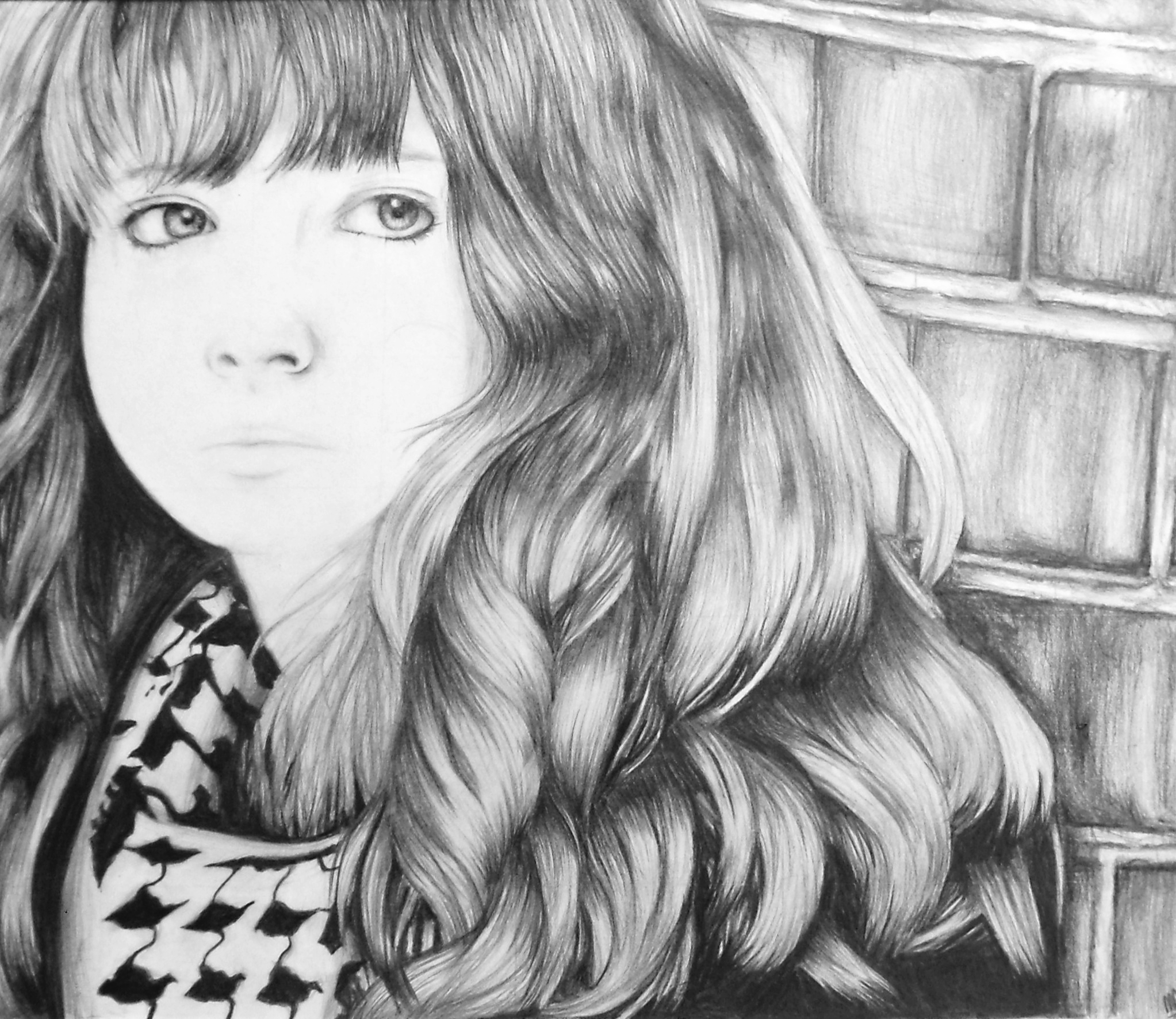
Megan is a rising sophomore and attends Burton Center for the Arts.
VIA: What is your medium of choice for creating your artwork?
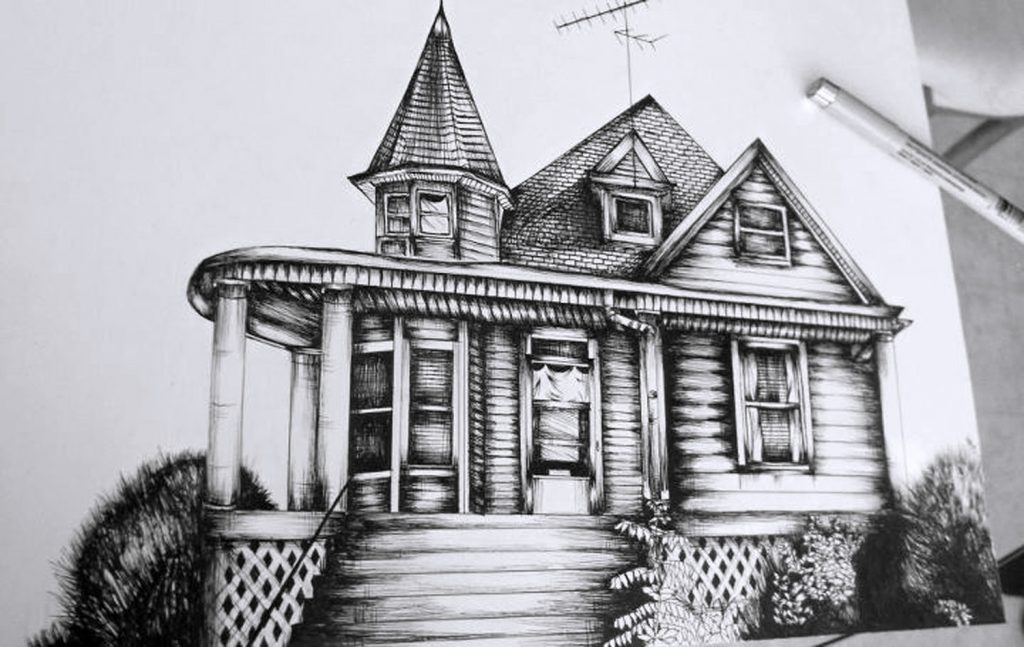
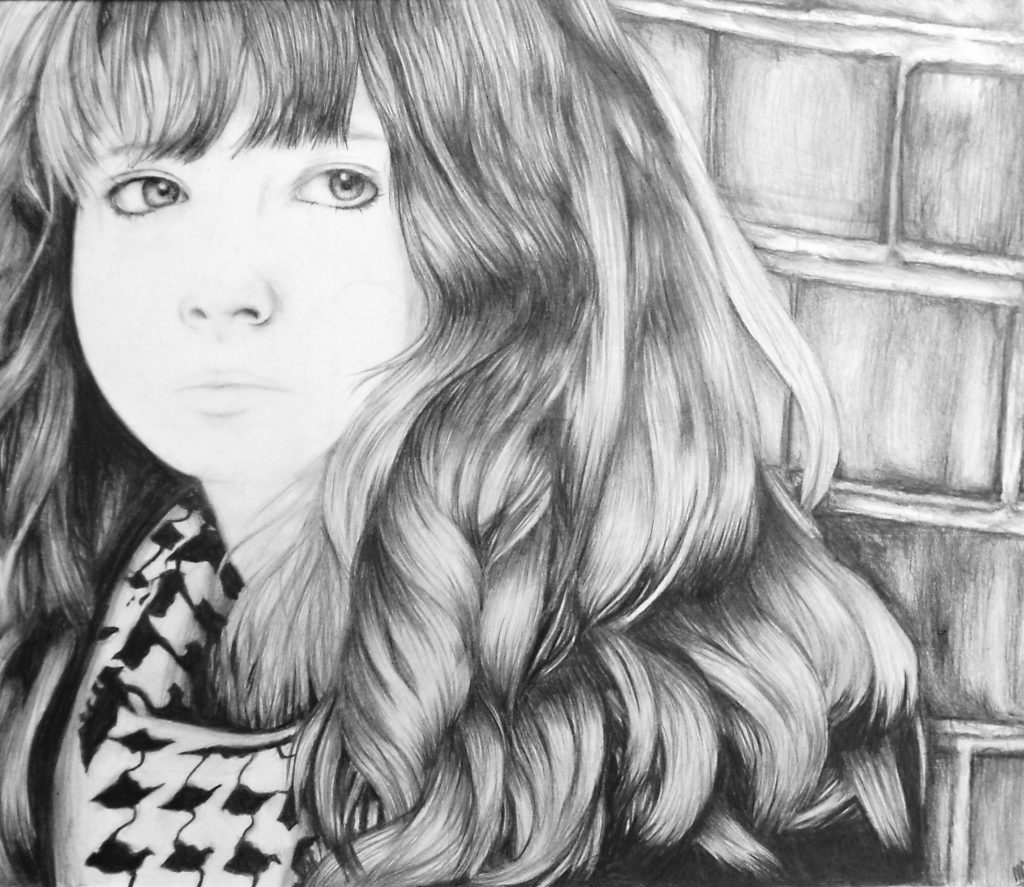
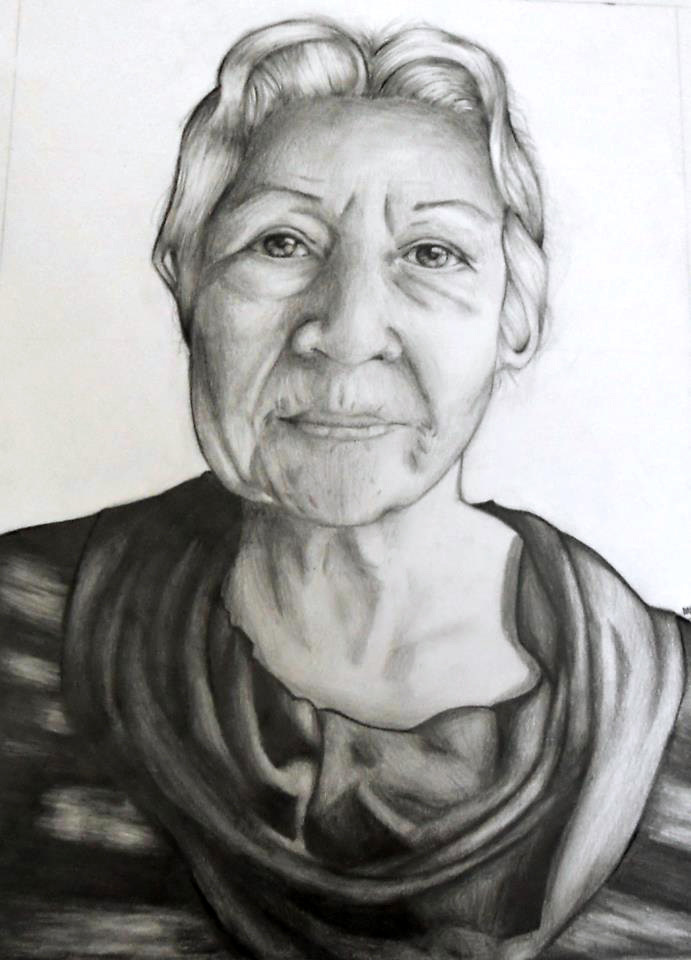
My medium of choice varies on what I’m doing usually, to be honest. If I have an idea that I think would look better painted, I paint, or if I think it would look better in graphite, I use pencil. My most used medium would probably be ink and ballpoint pen; I really enjoy working with ink.
VIA: What style or period of art inspires you as an artist?
A mixture of art from different time periods inspires me as an artist. I really love older works of art from the 1800’s and from the Renaissance; they’re big inspirations for me. At the same time I am inspired by a lot of more modern street art. I’m still learning so I try to draw inspiration from all time periods and styles of art!
VIA: Who are some of your favorite artists?
Since I first got started in art after looking at artists on the Internet, I have hundreds of favorite artists from different sites! When it comes to local artists, Toobz is my biggest inspiration. I adore his work; he’s really someone I look up to.
VIA: What are your plans for after high school?
I want to be a sort of Renaissance woman, by being established in various fields. My passions are art, music/ piano, and history. I have a lot of plans for after high school. I would like to become a professional artist, pianist/musician and plan to go to college to learn as much as I can about these subjects. If everything works out eventually settle down as a history teacher. It is a pretty ambitious plan but I’m going to try my best to get to my goals by starting to work on them now!
This article was originally published in the third issue of VIA Noke Magazine, printed in Roanoke, Virginia in October 2012.
Written by Judy Lochbrunner & the Double Line Painters of the Blue Ridge
Painting outside (plein air) is the ultimate way to enjoy the outdoors while challenging yourself to record in an art work a sense of place and time. Light constantly changes and demands that the artist work quickly and make decisions on what it is about the location that has inspired the artist.
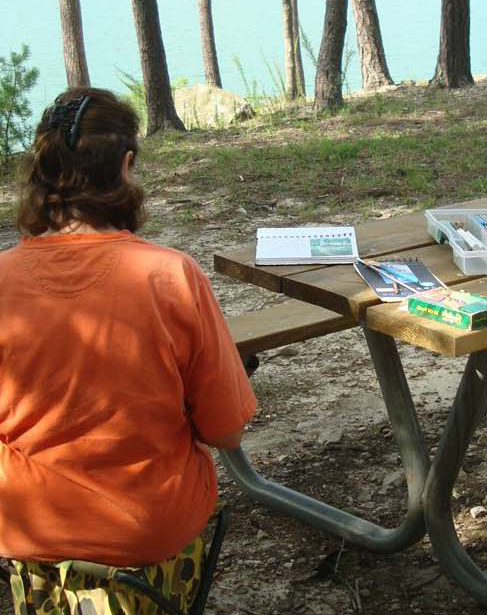
Mary Anne Meador uses a camp stool and picnic table along with colored pencils and a spiral drawing pad to set up for plein air recently at Carvin’s Cove.
Here in Western Virginia beautiful scenery is everywhere from sweeping mountain views to quiet places among the rocks or trees. Simply walking a favorite trail or local park will provide lots of inspiration. And taking the time to carefully examine and transferring that impression to paint and paper creates a “recollection” that contains all the senses.
Public parks and spaces are a good place to start by sitting on a bench, carrying a simple camping stool to the location, or just spreading an old blanket on the ground. Avoid blocking sidewalks, trails or a right-of-way. Never set up on private property without the property owner’s permission. Always use common sense and stay safe with drinking water, sunscreen, hat, bug repellant, cell phone, etc.
Start simple with expectations; focus on making a visual journal or diary and not a masterpiece or even a finished piece. Make a simple view finder by cutting a rectangle out of a piece of paper to help simplify the choices for the scene and reduce the frustration of trying to paint too much. Don’t be concerned what others may think or say just enjoy the activity. It can be fun and helpful to ask a friend to then share ideas and feelings.
The same simple approach applies to materials. Plan to begin with a sketchbook and a small set of colored pencils, markers, conte crayons or even just a basic pencil and eraser. Most artist sketchbooks are made for any dry media and will provide a good workable surface. It will be worth the investment in making the process easier.
Allow yourself the opportunity to explore, experiment and enjoy. And yes, it does take practice so don’t judge too harshly. Just get out and enjoy yourself while making art.
The Double Line Painters of the Blue Ridge are Judy Lochbrunner, Sue Furrow, Angela Shields, Martha Lalka, Linda Schaar, Bonnie Mason, Mary Anne Meador, and Midge Ovenshire. Visit their blog at doublelinepaintersoftheblueridge.blogspot.com
This article was originally published in the third issue of VIA Noke Magazine, printed in Roanoke, Virginia in October 2012.
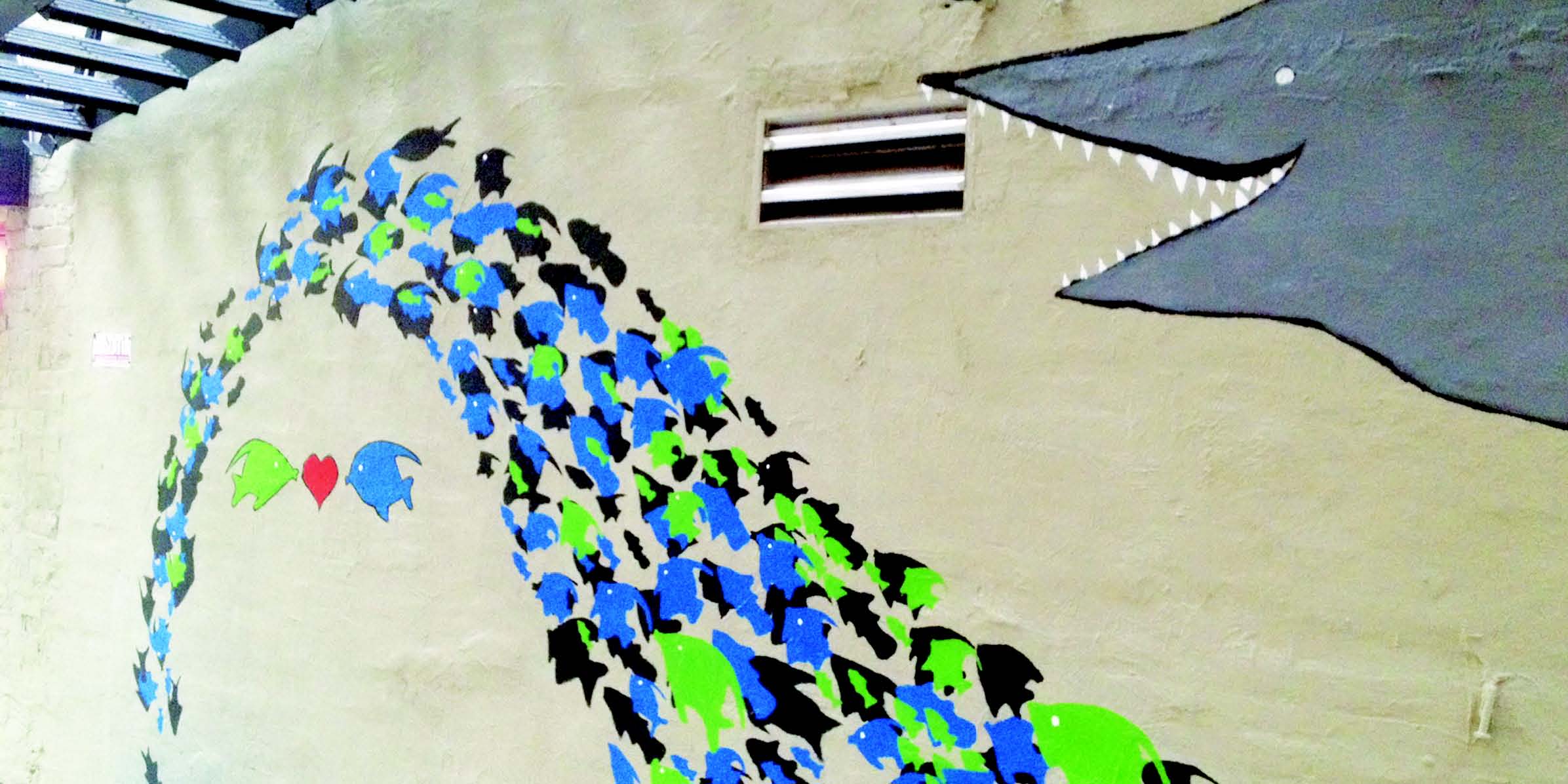
Wandering behind the Davidson’s building on Jefferson Street in downtown Roanoke is probably not something one does on a frequent basis, but it may be something you want to do soon. Curious minds will be surprised to find a vibrant work of art on the previously bare walls. A school of fish escapes entrapment and flows along the wall followed by a predator; two fish ignore the danger as they fall in love amongst the chaos. What a colorful story in such an unlikely place!
Couldn’t we all use a little more visual stimulation where we walk, work, and live? This is the main idea inside the mind of Mim Young, the founder of the Roanoke Art Mural Project (RAMP) and a “make things happen” kind of mover and shaker. Mim and her husband chose Roanoke when relocating in 1995 based on the strong local arts community. With pride for her new home she explains, “I’d really like to see us look as vibrant and wonderful as it feels to live here.”
There are many different projects brewing under the umbrella of RAMP, the first of these being community-based mural projects such as the one in Grandin Village. Local artist Toobz collaborated with Mim throughout last winter to conceptualize, plan, and paint the large and colorful piece on the side of CUPS Coffee and Tea last February. Featuring local residents Pearl Fu and James Tarpley, the mural shows appreciation for all types of people who make a difference in our local community. Mim’s goal is to complete projects like this in several different neighborhoods. “It will help them think, ‘Hey, I live in a good place.’ They already do feel that way, but they may not see anyone else thinking that.”
“The World is a Village” mural by Toobz for RAMP on the side wall of CUPS Coffee and Tea in Grandin Village.
Revitalization is another aspect of RAMP. Seeking to replicate successful revitalization mural projects such as Mural Mile in Philadelphia and Wynwood Walls in Miami, Mim has been working hard to gain the proper permissions and garner a strong community interest in the mural district she is proposing downtown. “I’m calling it a non-profit corridor,” she explains. “It’s between 1st and 5th street and its boundaries are Campbell Avenue, Salem Avenue, and Norfolk Avenue. In that area there is an abundance of non-profit organizations doing wonderful work in very non-descript buildings. They are under-funded and some of these people are only working part time, but they’re dealing with issues like homelessness, helping bring water and sewer systems to rural communities, and savings pets’ lives. There are all kinds of organizations down there and people go by those buildings and have no idea what is going on inside.” In an effort to inform the public about the ongoings of these non-profits, Mim hopes that colorful murals representing their work will educate and adjust the perspectives of passersby.
For both of these projects, collaborating with building owners throughout the process is key and ensures that the final product is truly something that represents the community or organization. “I definitely have a specific strategy involved, because I don’t want something to go up and people say, ‘What’s that!? Why did they put that there!?’ I want to stretch their minds and their eyes with what we deliver, but I don’t want it to be something that people don’t understand. I would like communities to get together and figure out, what is the message for this village? What kind of message do we want to convey? And then I can go and put out a call for entries and curate the choices that they have to choose from based upon the message that they want to convey.”
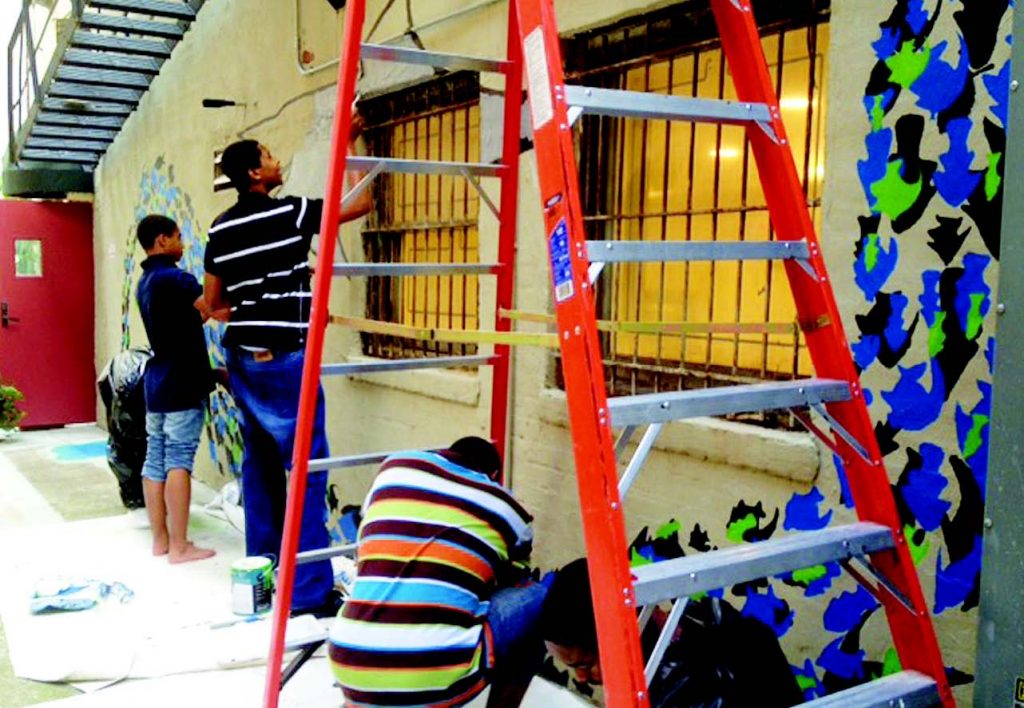
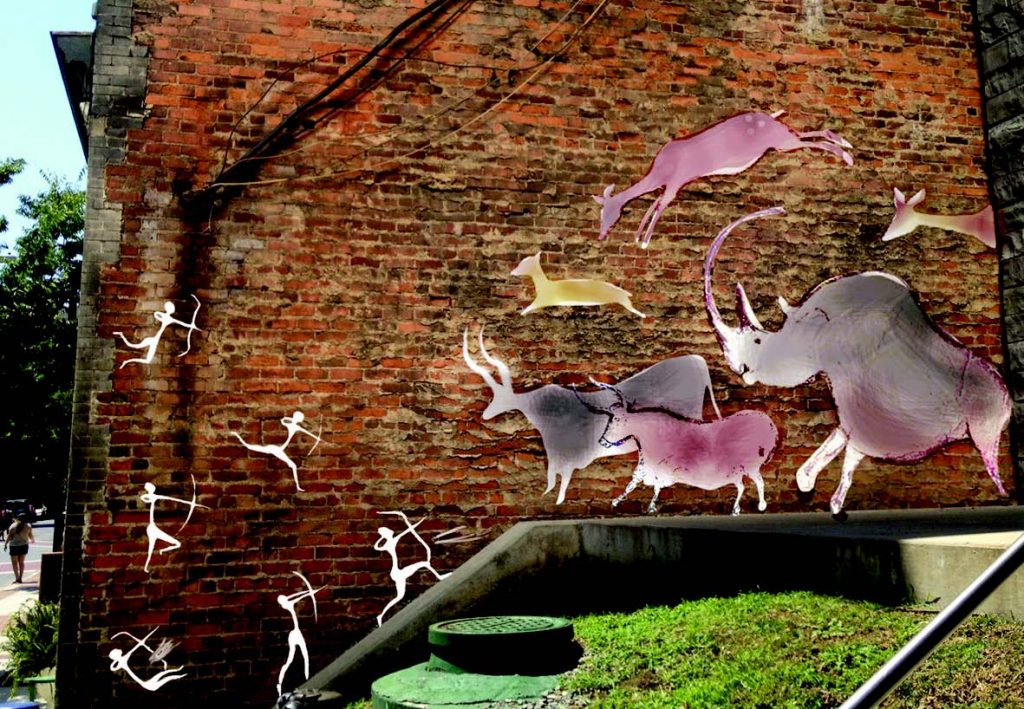
RAMPartists working on the mural on the back wall of Davidson’s in downtown Roanoke.Proposed design for a mural on side wall of Appalachia Press’ building in downtown Roanoke.
To ease these two larger projects into the public eye RAMP has partnered with The Arts Council of the Blue Ridge for support through their Roanoke Youth Art Connections program. This partnership has allowed Mim to educate and work with at-risk youth to conceptualize two different murals for downtown, one of which is the completed school of fish on the Davidson’s wall. “I think I enjoyed the workshops most,” she admits, speaking of the time spent with the students to educate them about different styles of art and to help them choose a style to work from for their murals. “I loved opening doors and windows of their mind to art, and helping them develop a visual vocabulary.” The next proposed RAMP – RYAC mural will be much more visible if all goes to plan; keep an eye out downtown throughout the next few weeks for another exciting work from these RAMPartists!
In addition to these large and lengthy projects, Mim would like to manage several miniature projects; painted crosswalks, colorful parking meters, and small guerilla-style pieces in unexpected places are just a few of her ideas.
Art Rat Studios, located in a sprawling Southeast Roanoke industrial complex, is home to visual artists Ralph Eaton and Brian Counihan. Both are community organizers, responsible for high-impact arts endeavors, including the annual Marginal Arts Festival. When I ventured over to their space on “the other side of the tracks”, both guys were busy in their adjoining studios. Brian had just shelved two massive paper-mache human puppet heads and Ralph was stabilizing a rod work archway entwined in neon swaths of material.
“Veiled,” Brian Counihan, oil on canvas
TIF: Brian, could you tell me about the work you are making?
BRIAN: I’m trying to work towards more veiled portraits, with drawing and painting together. I am also going to work on a large woodcut out of those paintings.
TIF: You’ve also been making large paper-mache heads that you wear…
BRIAN: Yes, I was envious of Ralph’s big [Marginal Arts Parade] floats, and I chose to make two snobby aristocrats.
RALPH: What was title, again?
BRIAN: Art is Revolting!
TIF: Ha, a double entendre?
BRIAN: They have a snarling expression like there is a bad smell.
TIF: So, how do you see your studio work and Marginal Arts Festival intersecting, do you make art specifically out of that interaction?
BRIAN: I see my work as being a part of community involvement, even my portraits are interactive for those that sit for them. The carnival theme of Marginal Arts Festival influences my work.
TIF: Ralph, what are you up to in the studio?
RALPH: Since I’ve gotten this studio my work has gotten bigger. Wherever I’ve worked dictates the work I might do, scale-wise, and in my so-called career I’ve had four studios and this is the best one yet. I’m working on doing a big installation project for an upcoming show at Roanoke College.
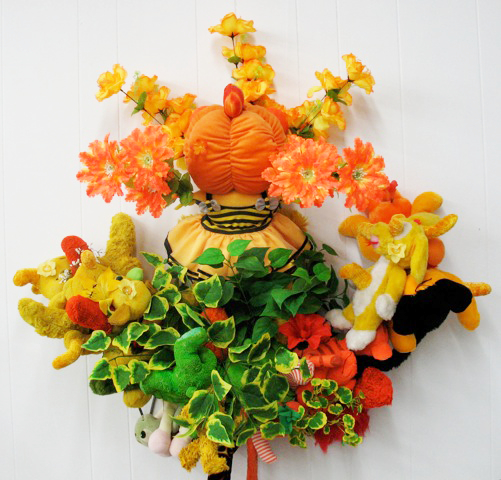
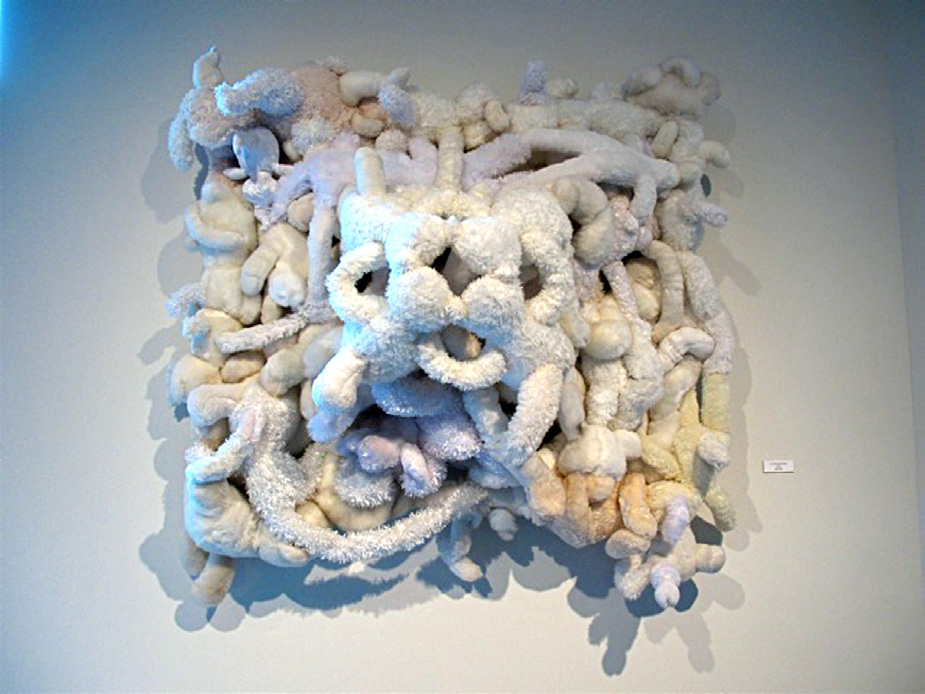
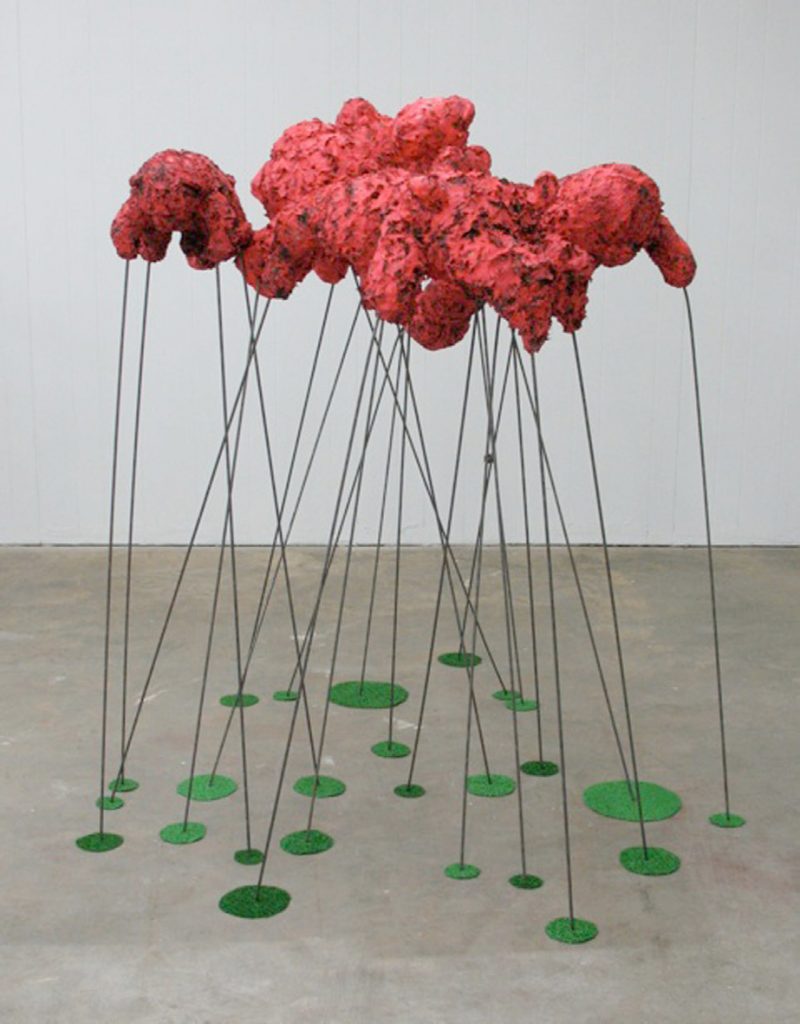
“Orange Anchor,” Ralph Eaton; stuffed animals, paint, artificial flowers, steel, glue, thread.Fuzzy White Wall Sculpture, Ralph Eaton; stuffed animals, steel, thread, glue.“Herd,” Ralph Eaton. Stuffed animals, steel, astroturf, paint, glue, thread.
TIF: Can you talk about your education?
RALPH: I started out as a painting major at the San Fransisco Art Institute, but I very quickly realized I was more of a sculptor. Paintings were more like objects to me, rather than windows to another world.
TIF: Tell me about your work for the Marginal Arts Festival parade and how your work building parade floats professionally intersects with your art making?
RALPH: I did make floats professionally for about ten years for the Rose Parade. It was one of the best jobs I ever had in my life. Specifically, I was a rod worker, or, in the industry, called a ‘rod god’ or a ‘rod jockey’. There’s not many of them. It’s a great fabrication technique. I use the float building process in all my sculptures, using rod work. It can be made very large and still fairly light. Since I moved back here, because I had parade experience, I became in charge of the MAF parade. It seems like people have fun with it. The parade depends on the community. Come on out and do anything you want to do! I would love to see more people build big floats and more crazy machines!
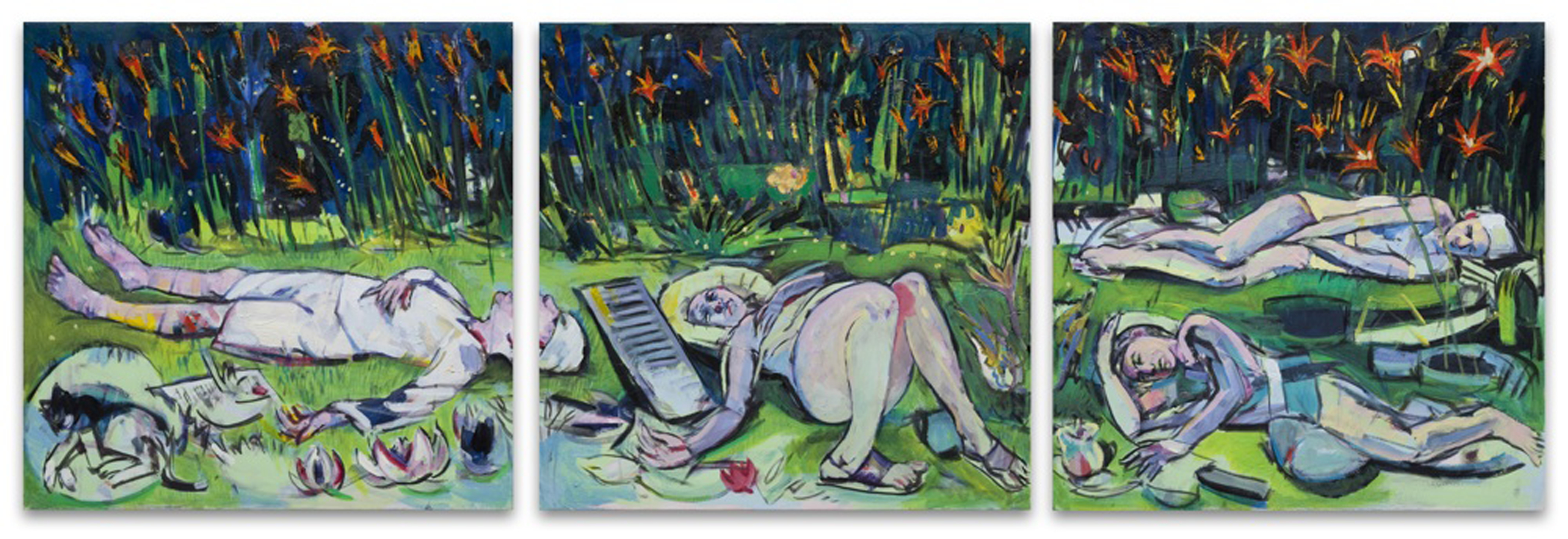
“Daylillies,” Brian Counihan, oil on canvas
TIF: Brian, could you talk about your role as a community builder and educator at Community High School?
BRIAN: I went to an art school in Ireland. Non-stop in the studio, with only one day focused on archeology or history. It was a very British system. I then went to New York, and lived there for nine years. Being in New York seemed to be education enough, so I didn’t go back to school there. I found I needed more of a context for my own work eventually, and chose humanities direction rather than one in visual art. I was really more interested in the arguments about what post modernity is, and understanding what it meant, rather than having a professor point at a painting and say, “Well, that’s post-modern”. I needed language to explain it. Coming out of that experience, I found I was interested in taking abstract ideas and finding language to contextualize it. I don’t think it really helped my art be any better, but it did help me communicate about art.
All this led me to my interest in teaching. I taught as an adjunct for several years, and then came into Community High School as a founding faculty member teaching humanities. Having the opportunity to change high school learning, to have a blank slate, was very exciting. We developed a curriculum based around the idea that in order for art to be useful in a high school, art education has to be linked to humanities. Basically, we explore the human condition. We learn it in history, and we learn it in art. We have a stripped down visual arts program teaching painting, drawing, photography, and film, but the focus is on the learning process of how to think independently like artists do. Too often what is taught in art education is just technique and self-expression. If we taught science as a therapy session, it would never prepare a student for college.
The students at Community High are prepared to talk about art. They are taught that art is more than just a physical process of making; it is a conceptual process with visual language. How is art socially relevant? How is art personally relevant? There is an endless set of questions students can ask about art.
This article was originally published in the third issue of VIA Noke Magazine, printed in Roanoke, Virginia in October 2012.
A review of Henry Horenstein’s SHOW by Naomi Deplume
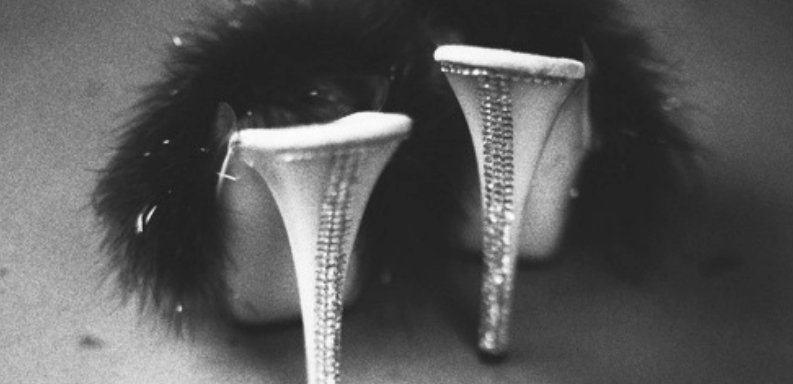
Ladies and Gentlemen! Come! Feast your eyes on exotic physical feats, daring décolletage and oddities of America’s erotic underground, all at the O. Winston Link Museum. Henry Horenstein’s SHOW is an exhibit of twenty-four black and white archival pigment prints in silver frames, ranging in size from 24 x 16” to 40 x 26”. SHOW covers the re-emergence of burlesque entertainment in America from 2001 – 2009 in venues like LA’s California Institute of Abnormalarts, NYC’s Slipper Room and New Orlean’s Shim- Sham Club. Performers Jackie Beat, Prince Poppycock, Miss Saturn, Violet Valentino, Amber Ray, Catherin D’Lish, Dita von Teese and others mix it up before Hornestein’s investigative eye.
In burlesque tradition we see the hips and bill-spangled legs of a faceless dancer presenting themselves to us in Fishnets, New York Burlesque Festival, Southpaw, Brooklyn NY, 2005. Peeking in from the right are the crossed legs of a cropped, presumably male spectator, anonymous and stiff. Our perspective is roughly the same as his. At the other extreme we’re confronted with frame filing close-ups, like Amber Ray’s chameleon eye and sexy lips. Her features are titanic, grotesque, extreme, and weirdly funny.
SHOW swings wildly in tone, from raucous hilarity to uncanny quiet. In Melody Sweets, This is Burlesque, Corio, New York, NY, 2008 a young gal poses in a tiled hallway between sets. Wearing nymphal feathers and pasties she smiles at us, the embodiment of an earnest, curative, sexy fun. In Jess, South Boston, MA, 2008 a woman plainly stands center frame before a sheer white background. She’s topless, wearing a giant teddy bear mask, and affecting an arty seriousness that seems out of place among all these flamboyant freaks.
SHOW is more about composition, texture and light than context or narrative, a departure from Horenstein’s environment rich Honky Tonk series. One exception is Helen Pontani and Peekaboo Pointe, This is Burlesque, Corio, New York, NY 2008. Left of frame in the background a spectator looks up from her cake, dumbfounded to see the titular stars in flamboyant gowns. What’s this? Sammy Davis Jr. and Dean Martin are peering out of their plumage. I’m slapping both knees here!
This is a great fit for the Link, whose namesake conspired to save the smoke, sound and immensity of an industry he loved from being pushed out of collective memory. By the 1970’s American burlesque was going the way of steam rail. Horenstein investigates its comeback. Burlesque is attracting audiences who’ve wearied of the vast, sterile, airbrushed array of entertainment sold via net and newsstand. Through ritualized spectacle, playful subversion, and laughter burlesque essentializes the visceral, lived experience of our varied and shared sexualities. ‘SHOW’ revels in the burlesquers’ glitter dusted details; here they are, warts, wrinkles, hair and all, their bodies bound in the pomp and pageantry of a re-born American subculture.
Editor’s Note: This column is written each month by different authors with diverse viewpoints. The opinions expressed in this article do not necessarily reflect the viewpoints or opinions of VIA Noke Magazine or its publishers.
This article was originally published in the third issue of VIA Noke Magazine, printed in Roanoke, Virginia in October 2012.